


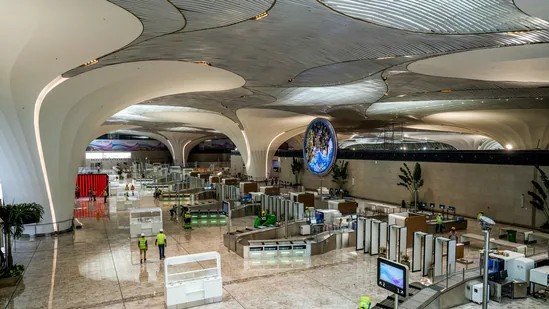
Prime Minister Narendra Modi will inaugurate the Navi Mumbai International Airport (NMIA) today (October 8). With this, Mumbai will join cities like London, New York, and Tokyo, which have more than one major airport.
The new airport is a modern, world-class facility built under a public-private partnership between Adani Airport Holdings and CIDCO (City and Industrial Development Corporation of Maharashtra Ltd). It is expected to start commercial flights in December 2025.
Here are 7 important facts about the Navi Mumbai International Airport:
1. India’s first fully digital airport:
The airport will offer online parking bookings, baggage drop, and immigration services. It will also have a smart, AI-enabled terminal to make travel smoother and faster.
2. Large passenger capacity:
In the first phase, the airport will handle 20 million passengers every year with one runway and one terminal. When fully completed, it will be able to serve 155 million passengers annually with four terminals and two runways.
3. Massive investment and job creation:
The airport has been built at a cost of ₹19,650 crore and is expected to create over 2 lakh jobs in sectors like aviation, logistics, IT, hospitality, and real estate.
4. Airlines ready to operate:
Major airlines such as IndiGo, Air India Express, and Akasa Air plan to start their services from the new airport, connecting cities across India.
5. Commercial flights from December:
Operations will begin in December, starting with 40% international traffic, which will gradually increase to 75%. The airport will initially function for 12 hours a day.
6. Smart and stress-free experience:
According to Arun Bansal, CEO of Adani Airports Holdings, NMIA will be an “anxiety-free airport.” For example, passengers will receive mobile alerts about their baggage, like which number it is on the conveyor belt.
7. Excellent connectivity:
Navi Mumbai Airport will be India’s first aviation hub connected to multiple transport networks, including expressways, metro lines, suburban trains, and even water transport